
 Whitehaven coal
14 May 2026
Harriet Davies named Exceptional Woman in Technological Innovation
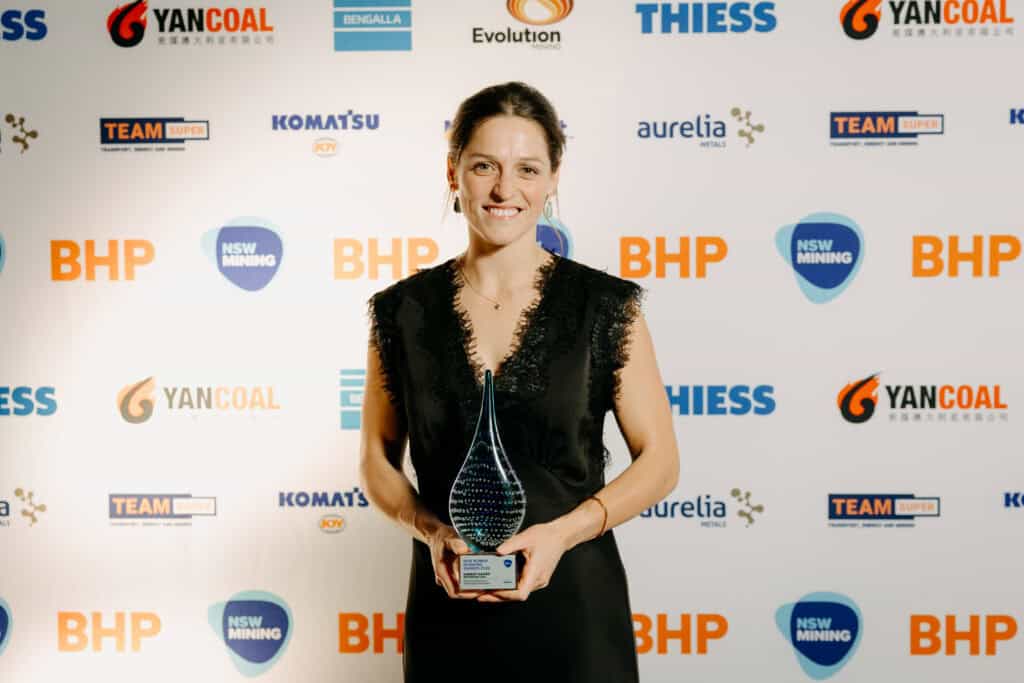
Growing up in the UK’s Welsh valleys, Harriet Davies was surrounded by mining history. Now, her career has taken her to north west New South Wales, where she is making her own mark on the industry as the winner of the Exceptional Woman in Technological Innovation Award at the recent NSW Women in Mining Awards.
Harriet arrived in Australia from Wales in 2019, spending time in Melbourne before heading to regional NSW. She entered the resources sector in 2020 through an onsite laboratory‑based environmental analysis role supporting Narrabri operations, where she developed a strong technical foundation in sampling, data quality and regulatory requirements.
“While the role strengthened my analytical skills, it also helped me recognise that I thrive in roles involving people, collaboration, and translating technical information into practical outcomes,” she says. This led Harriet to join Whitehaven and progress into her current role.
That progression has now earned Harriet significant industry recognition. An Environmental Advisor at Whitehaven’s Narrabri Underground Mine, Harriet’s success at the NSW Women in Mining Awards reflects her leadership in developing a purpose‑built environmental and rehabilitation data hub that is changing how the mine manages compliance, environmental risk and on‑ground decision‑making.
While proud to be recognised as an award winner, Harriet is quick to recognise the team around her. “I see it as very much a team effort. Projects like this don’t happen without collaboration and trust. But it is very exciting.”
The data hub emerged from a need to manage increasingly complex environmental approvals and surface disturbance requirements in a more reliable and transparent way.
“When I joined the Narrabri team, many environmental processes were still heavily paper‑based, relying on printed maps, handwritten permits and static digital files that limited visibility and increased the risk of error,” she says.
What began as an early‑stage concept has since grown into a centralised digital platform, designed to bring the mine’s environmental data into a single trusted dashboard system. The system is accessible to site teams, contractors and regulators alike, whether they are working in the office or in the field.
“It is equally functional for a contractor undertaking weed spraying or during a regulatory inspection,” Harriet says.
“It proves we’re doing what we say we’re going to do in a way that’s clear, accurate and easy to understand. The shift from a paper-based system to this real-time, accessible platform has made a tangible difference to day-to-day operations.
“Originally, a permit would be printed off as a hard copy and passed around between three or four different departments before it went out into the field,” she explains. “Whereas now, as long as you have your login, you can access it in the field, with or without internet connection, see the progress, see what’s required, and see who needs to be there.”
Harriet played a central role in shaping the system to reflect how work is carried out on site. Working closely with operations, environmental specialists, contractors and software developers, she helped translate regulatory requirements and operational workflows into practical, user‑friendly functionality. Extensive field testing, hands‑on training and staged implementation helped build confidence and drive adoption across the site.
The platform houses approval boundaries, inspection records, disturbance and rehabilitation tracking, borehole management and supporting evidence, with every action timestamped and supported by data captured in the field – and it continues to evolve alongside the mine’s regulatory obligations. When Narrabri moved into its Stage 3 approvals in August 2025, new requirements prompted further mapping development and system refinement. Harriet continues to work closely with mapping contractor IEMA (Integrated Environmental Management Australia) to improve usability and ensure the platform keeps pace with operational needs.
“The potential of the mapping and dashboard system becomes more apparent the more you use it,” she says. “Each time it’s applied, you begin to see more opportunities for improvement and further evolution.”
The platform is also attracting interest beyond Narrabri. With Whitehaven’s GIS capability continuing to expand in-house, the approach Harriet has championed at Narrabri is becoming increasingly relevant across the broader business.
Her role has also since expanded to include a strong focus on rehabilitation and Aboriginal cultural heritage, working alongside cultural heritage monitors whenever ground disturbance takes place on site, as well as leading the mine’s GIS mapping and data hub portfolio.
Harriet recognises the breadth of opportunity within the resources sector and the importance of making those pathways visible for others.
“Whatever people’s individual views on mining and resource extraction, the industry provides fulfilling and technically challenging careers.
“Women have every right to access those opportunities and contribute meaningfully.”
Living and working in regional Australia has reinforced this belief. While Harriet recognises the challenges women face in the industry, she also believes it offers women the chance to develop independence, resilience and leadership while building meaningful careers across environmental management, governance, rehabilitation, systems and technical fields.
Back to News