
 Whitehaven coal
2 June 2026
From the very first shift to the final day at Whitehaven’s Werris Creek mine
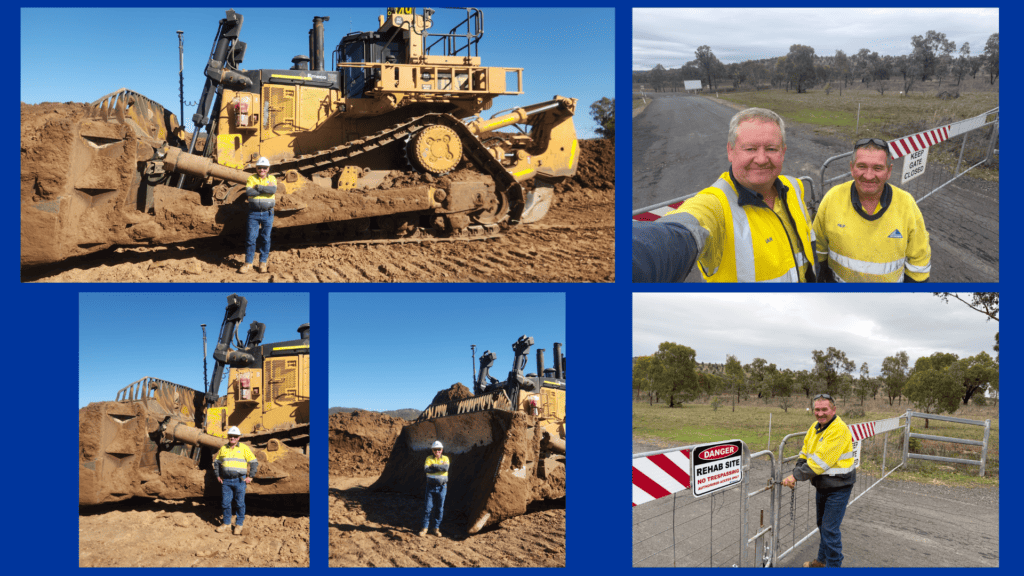
When Phillip Rumbel arrived at Whitehaven’s Werris Creek mine site in early 2005, there were no trucks, no equipment, and no workforce. Just a set of plans for an open-cut mine that didn’t yet exist.
“I was the first one here,” Phillip says. “It was just me and the project manager. We were here for two weeks before anyone else arrived. We had no equipment, no people. Just plans.”
21 years later, as Whitehaven officially closes its Werris Creek operation and transitions to monitoring and maintenance following the completion of final rehabilitation works, Phillip is the only employee to have been there since the beginning.
He came to Werris Creek following nearly three decades in the mining industry, having started in November 1976 at the age of 18 after a dairy farm he was working on near Singleton was shut down. He went on to spend years at Wambo Mining in the Hunter Valley before joining the contractor team that ultimately brought him north to Werris Creek.
The site itself has a much longer history. The Werris Creek Colliery was first operated by Preston Coal from 1925 to 1963 as an underground bord-and-pillar operation, supplying coal to the steam trains that passed through the town. When Whitehaven’s open-cut operation began in 2005, they eventually mined right through those original underground workings, a unique challenge Phillip describes as the most memorable of his career.
“Cold winter air funnelling through the old tunnels had the potential to feed oxygen to exposed coal seams, which meant the blast crew had to work around strict temperature limits.
“This challenge lasted for most of the mine’s life, only clearing in the final three or four years of operation. It was managed well, with safety always the priority, but it was a memorable highlight of working at Werris Creek.”
Throughout his time at Werris Creek, Phillip moved through a range of roles. He started as a step-up supervisor in the pit’s early days, moved to overseeing coal quality, then training and assessment, and ultimately drill and blast, where he spent most of his time. One of the constants he recalls in the training role was the role the mine played in upskilling local workers.
“Ninety-nine percent of our workforce was unskilled when they first joined. They’d never driven a dozer, only driven cars. So we had to train them up.
“I always called it a training ground for them. It was fantastic to provide opportunities to people in the local towns and see them thrive as they developed more skills. At it’s peak, the workforce consisted of 300 people.”
Over its operational life under Whitehaven, Werris Creek produced more than 26 million tonnes of high-quality thermal coal at an average of 2.5 million tonnes per year, making it the company’s lowest-cost producer. The site spent more than $200 million with local businesses and suppliers, paid $234 million in royalties to the NSW Government, and invested $3 million in local charitable initiatives across the Liverpool Plains. The site also received external recognition along the way, earning praise from the NSW Resources Regulator for operational excellence and a nomination for 2022 Mining Operation of the Year by the NSW Minerals Council.
Rehabilitation, which commenced over a decade ago across the site’s 470 disturbed hectares, has now been completed ahead of the originally projected 2027 deadline.
With last coal extracted in April 2024, roles and requirements at the mine changed. Many of the Werris Creek workforce relocated to Whitehaven’s other NSW mines, while others had the flexibility and experience to take on alternative roles at Werris Creek. For Phillip, his role shifted back to where he began in mining almost fifty years ago. He’s been back operating a dozer on the final earthworks of a mine he helped build from the start. As he reflects on his career at Whitehaven, Phillip acknowledges the tight-knit blast crew he worked alongside for so many years.
“There were only three or four of us, but it was as good a group as I’ve ever worked with,” he says.
“Everyone just got in, did their job and helped each other out. It made the days go quicker and the work a lot easier.”
Phillip also speaks highly of Superintendent – Mine Services, Ian Taylor, and his leadership through the mine’s closure. “You do the right thing by Ian and he looks after you. Simple as that.
“He wouldn’t ask you to do something he wouldn’t do himself, and he knows how to talk to people. You wouldn’t get a better bloke to lead you.”
With fifty years in the industry behind him, Phillip has clear advice for anyone considering a career in mining.
“Start on the ground floor as an operator and learn everything you can about the equipment.
“Getting in as an operator opens up a big door for where you can move in the industry. Because once you get your foot in, it’s easy to move around into other areas.”
But operating skill alone isn’t enough. Phillip believes the ability to think ahead is what separates a good operator from a great one. “You’ve got to have a forward plan always in the back of your mind. What we do today could make the job easier tomorrow. You’ve got to plan ahead.”
It’s a philosophy he’s applied across every role he held at Werris Creek, and one he credits for the opportunities that opened up throughout his career.
Life after Werris Creek for Phillip is already mapped out. His family runs a farm contracting business and a cattle trucking operation; ventures he kept running alongside his job at the mine for two decades. Retirement has never been part of his plan.
For the rest of the Werris Creek workforce, Whitehaven is fortunate that many have opted to relocate within the business rather than moving to work elsewhere. This high retention rate is a testament to the site’s management team and the high-performing culture they’ve developed.
Werris Creek mine – key statistics:
- 1925-1963: Werris Creek Colliery operated by Preston Coal (bord-and-pillar operation)
- 2005: Operations commenced under Whitehaven ownership (open cut operation)
- 2.5 million tonnes of coal produced each year
- 300 people: Peak operational workforce
- $200 million: Spending with local businesses and suppliers under Whitehaven ownership
- $234 million: Royalties paid to the NSW Government
- $3 million: Investment in local charitable initiatives across the Liverpool Plains
- May 2026: Rehabilitation concluded ahead of January 2027 schedule