
 Whitehaven coal
9 July 2026
Water management at Whitehaven: Why it matters
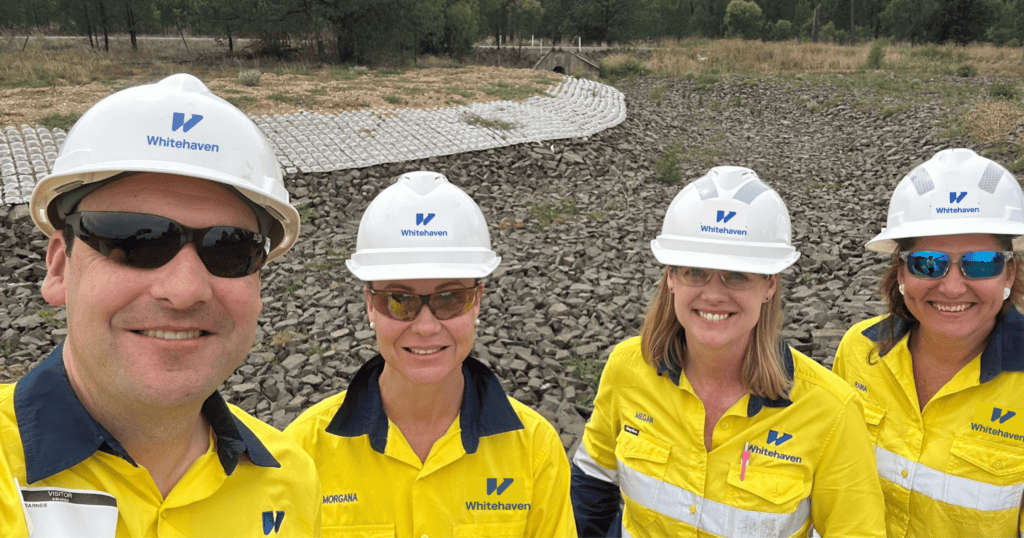
Water is a fundamental resource and for mining managing it well is critical to keeping operations running and maintaining healthy ecosystems. For Whitehaven’s Principal – Water Planning (NSW), Duncan Barnes, this is a daily responsibility.
With a background in environmental engineering, Duncan developed an early interest in water management and the challenge of solving complex problems in highly regulated mining environments.
“I used to work for consultants doing water management for mines,” he says. “Now, having joined Whitehaven just over two years ago, I’m actively involved in designing and overseeing that work.”
The move has given him a clearer view of why water sits at the centre of mine operations and what can go wrong when it is not managed well.
Striking the right balance
At its core, Duncan says water management is about balance.
“You are essentially managing two risks at once,” he added. “If a site runs out of water, production stops, but too much water creates its own problems.
“Water moves through a mine site in several ways, whether it be rainfall runoff across the site or from undisturbed areas, groundwater inflows into pits, or water required for processing and dust suppression. Without robust systems, these interactions can impact safety, production, infrastructure and downstream water quality.
“A poorly managed drainage system can halt production just as quickly as a mechanical failure, but the environmental consequences can last much longer.”
Getting the system right
At Whitehaven, that means thinking about water as a system – how it flows across a site, how it is stored, reused or released, and how engineered controls can reduce risk.
Water management is governed by each site’s Water Management Plan, which is approved by the applicable regulator, but for Duncan compliance is just the starting point.
“Good water management helps us meet our regulatory obligations,” he says, “but it also plays a big role in erosion control, site stability and protecting downstream environments.
“It is really about understanding where water is coming from, where it is going, and managing it properly.”
Duncan’s team regularly monitors the water balance at each of Whitehaven’s operations and works with them to plan and invest in water management infrastructure, and explores opportunities to minimise water usage.
Not all water is the same
Another key part of effective water management is understanding that not all water can be treated equally.
“Water is not just water,” Duncan says. “There are different classifications.
“You have clean water, which is runoff from bushland or water pumped in from a river. There is dirty water, which has come into contact with disturbed ground. And then there is mine water, which is any water that has come into contact with coal that is typically high in salinity and cannot be released off-site under any circumstances.”
Each type must be captured, stored and managed according to strict rules and controls.
Harnessing engineering and technology
For Duncan, effective engineering and design is about long-term outcomes, not just day-to-day performance.
“When you get the engineering right from the start, you’re not chasing problems, you’re preventing them.
“When I started out, you would see ‘artificial breadloaf landforms’ with highly visible rock lined channels that were pretty ugly and very obviously engineered,” he says.
“Now the focus is on rehabilitated landforms that mimic the natural landscape, creek lines and natural looking water features. It’s a big change.”
Technology is also changing how water is managed on site.
“Drones and other advanced technological tools can now survey large areas quickly, giving teams a real-time picture of where water is flowing and how drainage systems are performing,” Duncan says.
“You can see where the water is flowing and get survey data quickly. It has genuinely improved how we manage things on the ground.”
After more than two years at Whitehaven, Duncan is still finding new challenges. “Every site is different,” he says.
“The catchment is different, the operational layout is different, the challenges are different. You cannot just copy what worked somewhere else. You have to understand the system you are actually dealing with.”
“That’s what keeps me engaged and motivated to continue driving positive water outcomes across our operations.” You’ll find more information about Whitehaven’s commitment to water management in their 2025 Sustainability Report.
Back to News